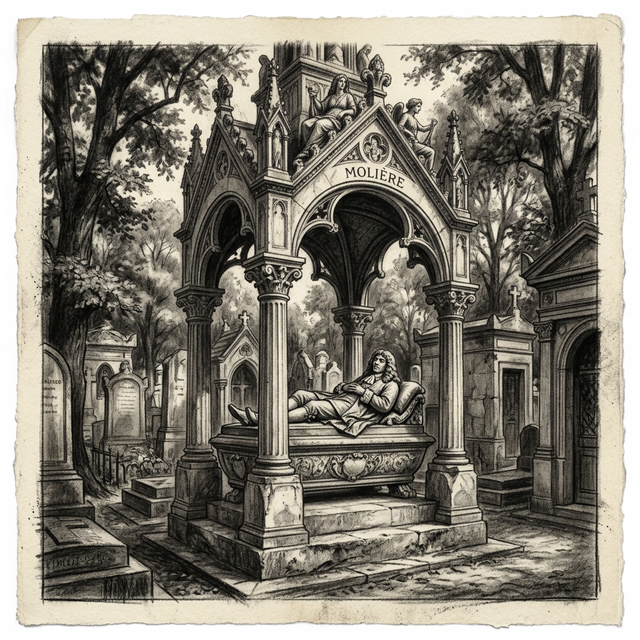
Molière
"The greatest comedian of French literature. Author of 'The Imaginary Invalid', 'Tartuffe', and 'The Misanthrope'."
Epitaph
“Ici repose Jean-Baptiste Poquelin de Molière”
English Translation
“Here rests Jean-Baptiste Poquelin de Molière”
Tumba Real
Este espacio resalta la tumba real en el cementerio.
¿Tienes una foto real? Aporta a nuestro archivo histórico subiéndola abajo.
Detailed Biography
Jean-Baptiste Poquelin, better known by his stage name Molière, was the greatest genius of French comedy and one of the most influential playwrights in universal literature. Born in Paris in 1622, Molière not only wrote works that are now cornerstones of theater but also acted in them and directed his own company, often facing censorship and the wrath of the powerful due to his sharp social satire. His ability to dissect human vices through humor made him a favorite of the "Sun King," Louis XIV, but also an enemy of the Church and the more conservative sectors.
The Son of the Royal Upholsterer Who Chose the Stage
Son of a prosperous royal upholsterer, Jean-Baptiste was destined for a comfortable life at court. However, his passion for theater led him to found the "Illustre Théâtre" alongside the Béjart family. After years of hardship and initial failures that even landed him in prison for debts, his company toured the French provinces for thirteen years, a vital learning period during which he honed his technique and deep understanding of human psychology. In 1658, he returned to Paris, where his play *Les précieuses ridicules* definitively established his reputation.
The Great Comedies and the Struggle with Hypocrisy
Molière invented the "comedy of manners," where humor ceased to be merely buffoonish and became a mirror of society. In *Tartuffe*, he attacked religious hypocrisy in such a way that the play was banned for years. In *The Misanthrope*, he explored the loneliness of the honest man in a world of appearances, and in *The Miser*, he portrayed the blindness produced by greed. His characters, such as Argan or Tartuffe, have entered common language as archetypes of universal human flaws.
The Art of Dying on Stage
Molière's life ended in the most theatrical manner possible. On February 17, 1673, during the fourth performance of his last play, *The Imaginary Invalid* (in which he himself played a man who always believes he is dying), Molière collapsed in the midst of a coughing fit and blood. Despite his condition, he insisted on finishing the performance so as not to disappoint the company’s workers. He passed away a few hours later at home, having not received the last rites, as at that time actors were denied burial in sacred ground.
The Mystery of Père Lachaise
Due to his profession as an actor, the Church initially refused to bury him. It took the direct intervention of Louis XIV for him to be granted a discreet burial, at night and without pomp, in the cemetery of Saint Joseph. During the French Revolution, his supposed remains were transferred to the Panthéon and, finally, in 1817, to the newly created Père Lachaise cemetery, where he now rests alongside his friend La Fontaine. His bust presides over a grave that is a place of pilgrimage for all theater lovers, reminding us that laughter is the most powerful tool for telling the truth.
Burial site
Have you visited this tomb?
Help complete this historical epitaph.
Upload functionality coming soon
Know another interesting epitaph?
We are building the largest collection of historical epitaphs. If you know a famous or curious epitaph you can send it to us.